Steppenwolf Theatre Company's The Dance of Death
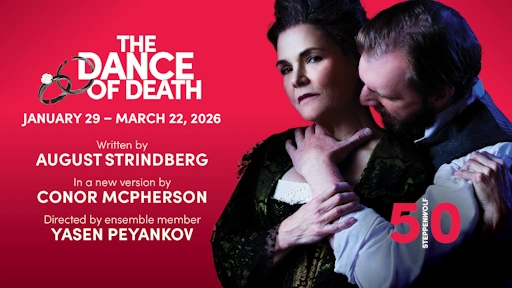
Image courtesy of the Steppenwolf Theatre Company
Kathryn Erbe is an actress, best known for playing Alexandra ("Alex") Eames on Law & Order: Criminal Intent.
She's currently playing "Alice" in The Dance of Death at the Steppenwolf Theatre.
She joined me via Zoom to discuss her career, Steppenwolf's 50th anniversary, and The Dance of Death.
To watch the interview with Kathryn Erbe, click the play button below (or click here to open the video player in a new tab/window).
Click here to display the video player on this page.
To listen to the interview, click the play button below (or click here to open the audio player in a new tab/window).
Steppenwolf Theatre Company's The Dance of Death runs through March 22, 2026 at the Steppenwolf Downstairs Theater in Chicago, Ill.
More information about the show, as well as ticketing information, can be found on the Steppenwolf website.
Mike Reflects
While I strive to see the shows I talk about, it's not always that easy.
Sometimes it's a show that's still in rehearsals, sometimes it's a tour that hasn't gotten to town yet, and sometimes it's just difficult for me to get there.
But whether or not I've seen the show, I love discussing the art and the processes that go into making it, and I absolutely love when my guests are just as open to exploring that, as Kathryn was.
Like I said in the interview, I primarily talk to people who are best known for their work in comedy (TV, movies, stand-up, etc.). While many of them have also done smaller dramatic or dramedy roles, it's not what most people (myself included) know them best for, and, thus, it's not the focal point of the conversation, if there's time for it to come up at all.
Kathryn's years as the lead in Law & Order: Criminal Intent not only provided an opportunity to explore that side of the industry more thoroughly, but also provided a unique lens through which we were able to explore her stage work, from the dramatic to the comedic.
And this show, spanning both along its various stages of development, was the perfect show to really explore those shifts.
It's a fascinating look at how various interpretations can paint a source text in very different lights, as well as how one can change the entire tone of a production without changing the underlying words.
At its core, it's really a look at exactly what the Steppenwolf exists to showcase: the collaboration between the text, the director, and the cast in bringing a play—especially a nuanced play—to life.